
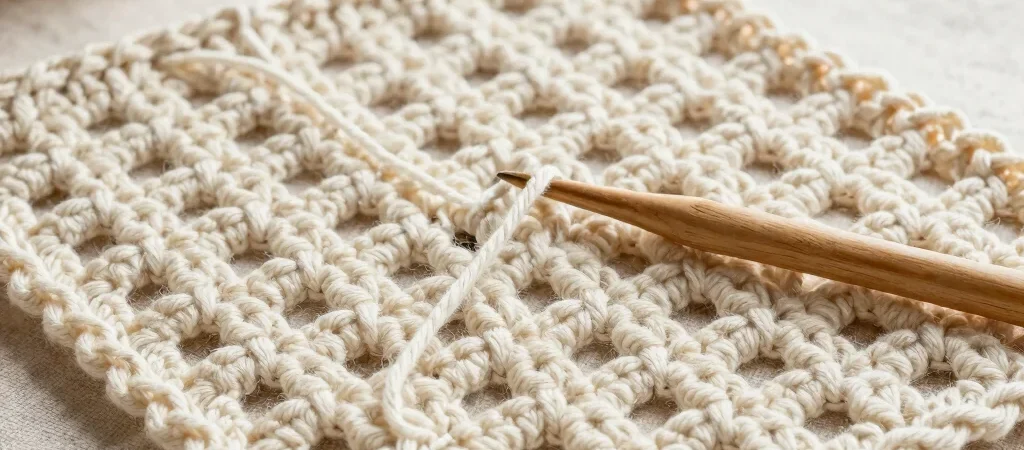
The first row is finished, but the bottom edge gathers like a drawstring. That often means the foundation chain is tighter than the stitches worked into it. You do not need to tug harder or force the fabric flat; give the chain a little more room as you make it.
Give Each Chain Room
When you yarn over and pull through, let the loop rest on the wider part of the hook rather than cinching it down against the throat. Keep your grip comfortable and allow the working yarn to feed through your fingers without pulling it taut after every chain. The loops should be even, but they do not need to be tight.
Make a short practice chain and work a few stitches into it before beginning the project. Check whether the base edge lies reasonably flat and whether you can insert the hook without straining. If it still draws in, try a slightly larger hook for the foundation chain, then switch to the pattern hook for the first row; test this on a small sample first because it can affect the edge.
Check the First Row Early
After working the first row, lay the piece on a flat surface without stretching it. A gently flexible edge is a better sign than a tightly puckered one, though the fabric may relax a little with handling. If the chain is too tight to work into, undoing that short section now is easier than trying to correct it several rows later.
Some patterns ask you to work into the back bumps of the chain for a tidier lower edge, but that changes where you place the hook, not the need for comfortable tension. Follow the pattern's instructions and keep the stitch count steady across the row. A relaxed foundation makes the start of a project feel more manageable, stitch by stitch.